Ads used to be here |
 |
 |
 |
 |
 |
 |
 |
 |
|
"IT TAKES COURAGE" by Christopher Chow* Pioneer Emmy Award-winning
journalist Chris Chow issues a SAN FRANCISCO, CA -- It's known as "The Business" among insiders, the practitioners of journalism in the mass media industry.
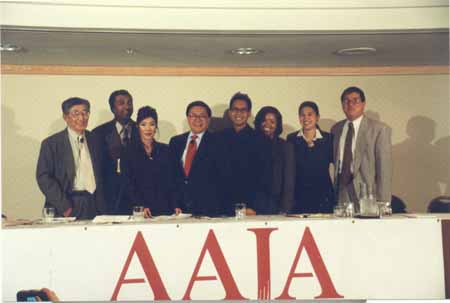
This August while the Hyatt Regency Hotel housed the 14th Annual National Convention of the Asian American Journalists Association, celebrating its 20th year of life, it was business as usual. But with a brutal twist - there are no jobs to be had, especially if you're Asian American, new, or serious about fulfilling the journalistic mission: to defend and promote a free and just society through the power of information and ideas. Worse yet, the AAJA membership conducted no serious business, did not discuss lessons learned, and enacted no resolutions or recommendations for the future. One of the inherent problems of the AAJA convention - present, past, and future, is its aping of the industry and the organizations it seeks to change. Schoomzing, er, networking. Careerism. Self-promotion and self-advancement. Job fairs and one-on-one critiques with alleged recruiters and headhunters sitting in front of tv/vcr combos telling you how good or bad your sample reel looks and the wonderful potential opportunities they offer (but are not offering to you). Young yellow journalists today are like the "neo-Mandarins" of Asian America being "thrown into the Roman arena" says K.W. Lee, 73-year-old Korean American pioneer journalist and four-time Pulitzer Prize nominee. His 40-plus years in mainstream newspapers from West Virginia and the East Coast to California give him the perspective of wisdom and experience. He reminds us that when the "media honchos of LA Times and the television networks" pitted Koreans and Blacks against each other in a manufactured race war in south central Los Angeles (1992), no one in AAJA spoke up for the Koreans, except for one Bill Wong, then a columnist with the Oakland Tribune, and now occasionally for the San Francisco Chronicle. Lesson learned: we are meat for the media. This year's AAJA convention was a pauper compared to the princely entertainments of the past. The dot-com downturn, the catastrophic drop in advertising because of the cataclysmic closing of high-tech high-flyers and the resultant bear market on the stock exchanges meant the wholesale wipe-out of jobs -- and for Asian Americans, the model minority standard of living they had come to expect as their entitlement. I sat in one workshop where a managing editor at Red Herring, a tech communications company, told of how he fired hordes of journalists - hundreds, thousands, in multiple rounds of lay-offs. It was like a reverse cattle call, or lambs being led to slaughter. He had to fire so many people in one day that he sent an assistant around to the cubicles tapping the shoulders of those (in groups of 20-30) who were to report to the firing room. The guy from the Miami Herald, part of the Knight-Ridder chain and a major sponsor of the convention, boasted that since down-sizing his staff, his product has improved (a Pulitzer in each of the last four years): "The cream will rise to the top." Lesson learned: more for less is management's nirvana. Unease was in the air. Tritia Toyota, the first Asian American woman tv news reporter and anchor in Los Angeles and co-founder of AAJA, had been invited as a special guest. She declined. She's no longer in the business. Some say she feels AAJA has lost its way, that it is no longer trying to fulfill its original mission of fighting stereotypic media images and protecting journalists. Bill Sing, another co-founder, gave the convention keynote speech at the national awards luncheon. Rumor had it that he was reluctant to accept the honor. Sing named some of the pioneers and leading practitioners: Connie Chung, the first Asian American anchor on a network evening news; Ken Kashiwahara, former ABC News correspondent; and Bill Wong, the newspaper pioneer. But they were not attending either. In his address, Sing summed up the substantial accomplishments of AAJA, but warned, "Friends, we still have a long way to go. Look around, how many Asian American publishers of mainstream newspapers and magazines are here in the house? Around many Asian American editors in chief, station managers, news directors, are there any Asian Americans on the boards of our leading media companies How much influence do we really have? If a tv station fires its Asian American anchor or fails to have on-air talent that reflects the diversity of its community, can we do anything about it?" (As in what happened to Tritia Toyota in LA, or myself in SF). In short, why doesn't AAJA have clout? Why doesn't AAJA have any respect in the Asian American community at large, in the world of media, or at least enough to help shape policy in the newsrooms of America? Lesson learned: you can't rest on your laurels and expect to last - the work is unfinished. If AAJA can get the Hearst-owned Chronicle, Daimler-Chrysler, CBS, and other corporate giants to pay for the shuttle buses, tote bags, cameras, computers, websites, and other things to stage this convention, why can't AAJA be a credible voice in the industry? Lesson learned: beware of bootlicking. The serious part of the convention - the workshop panels, the plenary sessions, where the pros gather to discuss latest trends and how to elevate their work - did not make news. Ted Fang, the first Asian American publisher of a major metropolitan newspaper in the continental United States, had no role other than to speak at the opening plenary on Media, Technology, and the New Millenium before a desultory crowd of 200 out of near 1,000 registered conventioneers. Unlike the real world the AAJA plenaries don't debate policy issues concerning the organization itself or its work. There are no resolutions expressing the will of the majority or wisdom of the organization on such important issues as demanding the release of the government files on the Wen Ho Lee case to help the public determine if racial profiling and ethnic scapegoating had indeed been committed by the powers that be. AAJA has a good administrative staff. They've shown they can organize and run conventions and provide professional services. But they are not policy advocates nor authorized by the membership to lobby policy-makers and decision-makers in the industry or government. AAJA has no on-going high or low-level relationships with OCA, JACL, AALDEF, to name a few national advocacy organizations. If AAJA could put the voice and weight of its membership and allies behind a policy recommendation or stance on an issue, then when it speaks, people might listen. Lesson learned: Hire a policy director, form a policy committee, and really think about long-term goals and strategy. Wendy Tokuda, co-founder of the San Francisco AAJA chapter, and a top Bay Area news anchor, had tears in her eyes following the Special Recognition Award given to the Woodwards of Bainbridge Island, outside of Seattle, Washington for continuing to publish news of Japanese American families who had been evacuated to internment camps. Paul Otaki, one of the "Camp Correspondents" hired by the Woodwards, spoke of asking them, "Why did you do this, why suffer the anger and hate and ugliness of some of your readers? They would always reply, this was the right thing to do." Wendy departed from script and ad-libbed, "It strikes me in listening to Paul talk about it, is what kind of courage it took to speak at that time, to speak out at all. And what strikes me as a reporter, and a reporter of Asian American descent, was if any of you who were working in the newsroom at the time that American jet was sitting down on Hainan Island would know that a lot of those feelings about being different- and making a difference, I think that you have sense of the work that we have yet to come." Afterwards, Sam Chu Lin, pioneering broadcaster and contributor to Asian Week, asked Wendy what was she saying to her fellow AAJA members. She answered, "That it takes courage to tell the truth. That it takes courage to be different. It takes courage to manage it, to handle it in the newsroom, in terms of news judgment. It's hard to have a minority opinion." Lesson learned: You gotta have heart, or the business will crush you.
*Christopher Chow is an Emmy Award-winning journalist.
In 1970 he had the courage to break the yellow color line in San Francisco
commercial television. He now works in administration at Central City
Hospitality House in the Tenderloin community of San Francisco. AsianConnections.com's features are viewed
by millions of people around the world.
|
||||||

 |
|||
|
 |
|
|
| | About Us | Disclaimers and Legal Information | Advertise With Us | We welcome your comments. Send e-mail to us at info@asianconnections.com Copyright ©1999-2002 AsianConnections.com |